Book a Demo

Experiences / Intelligent Living

Intelligent Living

Sensing in the fabric
of the walls. So it disappears.

It is in every room, on every wall, touched every day. Put the sensing inside the switch and it vanishes into the building, reading how people really live so young and old can stay independent longer, in a home that feels premium rather than clinical.

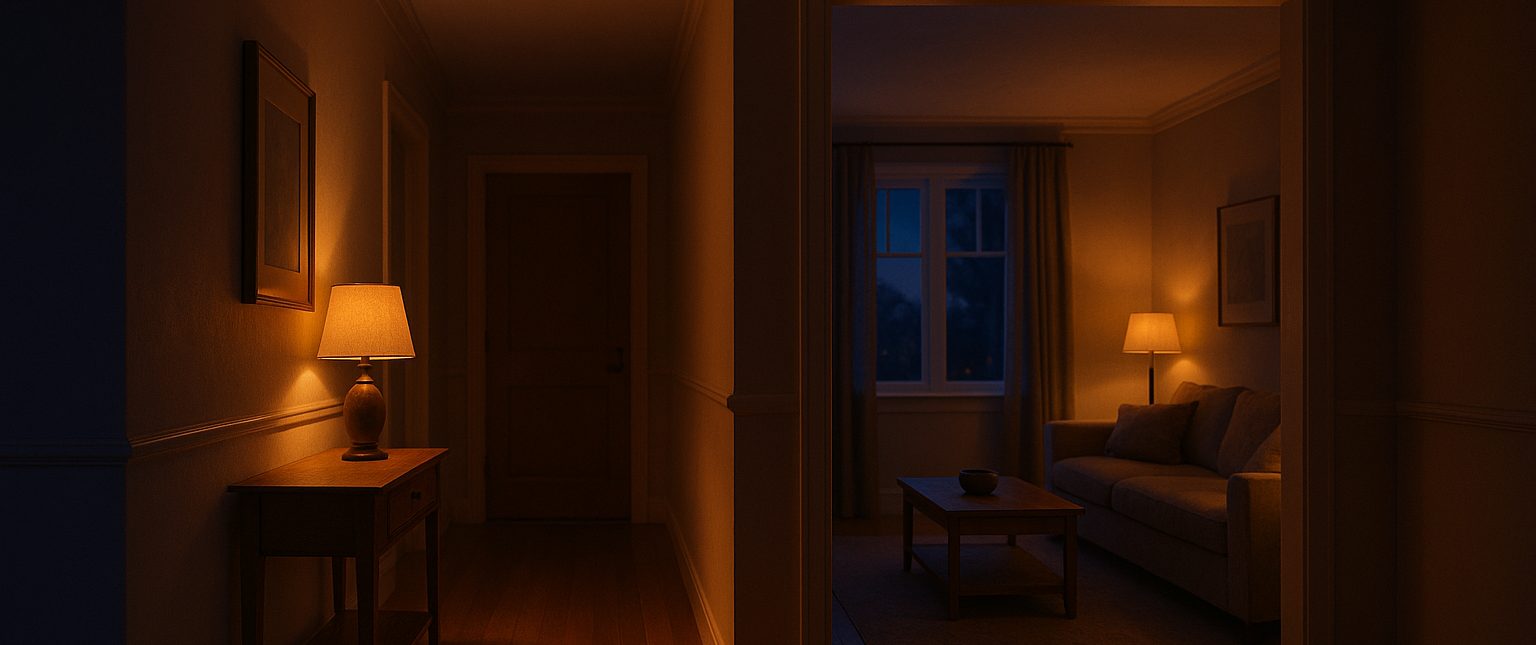
An apartment living room in the evening, lit softly by lamps and ceiling light, with a resident reading in an armchair

What the research says

Change the light, change the odds.

Lighting is one of the few fall risks you can fix with a purchase order. It has been studied properly, in real buildings, with real residents.

43%
Fewer falls in care homes that switched to lighting bright by day and dimmed overnight, across 758 residentsJAMDA 2022
34%
Fewer nighttime falls with warm amber light framing the bathroom doorwayJAMDA 2024
7 in 10
Care facility bathrooms measured dimmer than the recommended level for what people do in themJ Appl Gerontology 2025
Sleep
Bright light late at night is linked to more insomnia and higher overnight blood pressure, so more light is not always the answerIJERPH 2021

The catch

Bright light helps by day and hurts at night.

Those last two findings pull against each other, and that is the problem with ordinary lighting. A fixture bright enough to keep someone steady on the way to the bathroom is bright enough to ruin the sleep they were going back to. A switch with no idea whether the room is occupied has to be set one way and left there.

A switch that senses the room can do both. Bright when someone needs to see, low and warm when they need to sleep. That is the whole idea on this page.

How it works

Light that knows someone is there.

Three moments where it matters, and what actually happens in the room.

A resident sitting on the edge of her bed at night with a soft amber glow along the floor leading to the bathroom

At night

A soft trail to the bathroom, not the overhead light

When someone sits up in bed, a low warm glow comes up along the floor toward the bathroom. Enough to see where you are stepping. Not enough to wake you properly or tell your body it is morning. It fades away once the room is empty.

A bright, well lit residential bathroom with even light and no dark corners

In the bathroom

Full light the moment someone walks in

The bathroom is where falls concentrate, and it is the room most likely to be too dark. Seven in ten measured bathrooms came in under the recommended level. Presence sensing brings the light up properly the instant someone enters, with no switch to find in the dark and nothing to remember.

A sunlit open plan apartment in the morning with bright, cool ceiling light

Through the day

Brighter mornings, warmer evenings

Rooms come up bright and cool in the morning to reflect natural daylight, then gradually shift to warmer tones in the evening. This daily rhythm mirrors the approach used in the 43% study, while remaining subtle enough to feel like part of a comfortable apartment rather than a visible system.

The foundation

Every room already has a switch.
That is the opportunity.

This is the part that matters most, and it is not about luxury. A community that senses presence room by room can see whether someone's daily pattern is holding steady, improving, or slipping. Not a live view of anyone's apartment. The shape of a normal week, and what changes about it.

A modern smart dimmer switch on a pale wall with a slim illuminated indicator

Sensing in the wall

The sensor is the light switch

Inovelli's Red Series presence sensing dimmer puts millimeter wave radar inside the switch itself. It goes in the same box as the switch it replaces, on the same wall, fitted by the same electrician. Nothing on the ceiling, nothing on the resident, and nothing that makes an apartment look like a clinic.

Leviton covers the rest of the property where presence sensing is not needed. Care Daily also speaks Matter, Thread, ZigBee, Z-Wave and Z-Wave Long Range, so lighting is a first step rather than a lock-in.

Sleep
When the day starts and ends, and how settled the night was
Mobility
Movement between rooms, and how that shifts over weeks
Social
Time spent out of the apartment, which tracks with engagement
Safety
Occupancy in the rooms and the hours where risk is highest

For your team

Nobody can check on two hundred apartments.
The building can.

With residents opting in, Care Daily can help teams recognize meaningful changes in daily routines, such as increased nighttime activity, later mornings, or shifts in evening patterns. These changes may be easy to miss when viewed one day at a time, but over time they can help provide a clearer picture of how a resident's routine is changing.

By bringing those patterns to the attention of staff, Care Daily gives teams an earlier opportunity to check in, offer support when needed, and document the actions taken.

For the community

Isolation is harder to see than a fall.

A resident who stops leaving her apartment sets off nothing. There is no incident, no report, and no moment where anyone is told. Time spent out of the home is one of the few signals a building can read without asking a resident to wear a device or fill anything in.

What changes

Out most days, then out twice a week

The shift is gradual, so it reads as normal to anyone seeing one day at a time. Across a month it is obvious, and it usually starts before anyone mentions feeling low.

What you do

An invitation, not an intervention

Life enrichment gets a name and a reason to knock. A seat saved at the table, a ride to the thing she used to go to. The response is social, because the problem is.

What it protects

Occupancy, and the reason people stay

Residents who stay connected stay independent longer, and they renew. Engagement is the outcome families ask about on the tour and the one nobody can currently measure.

Beyond presence

An ordinary day has a shape.
The apartment can read it.

Presence sensing tells you a resident is in the kitchen. The rhythm of the home tells you she made a meal. Intelligent Living reads the ordinary rituals of an independent day, a meal prepared, an evening settled into, a light on at dusk, and turns them into a picture of how someone is really living between visits. No cameras, no microphones, nothing worn, and nothing anyone has to remember.

It is pattern insight, not personal content. Care Daily does not know what is on the television. It knows whether the evening still looks like her evening. That distinction is the whole design, and it is why this reads as a better apartment rather than as being watched.

Independence over time

A trend line, not a bad day

One late morning is nothing. A month of them is a conversation, and six months of them is a decision about where someone lives. Care Daily holds the long view, so that conversation can start early and calmly, grounded in months of daily life rather than a single incident.

Meals

A kitchen that is still in use

Preparing food is one of the first independent activities to change, and one of the last a resident will mention. The home notices the week the kitchen goes idle, rather than the month somebody finally thinks to ask.

Evenings

An evening that still looks like hers

A settled evening has a rhythm to it, and an unsettled one does not. We have no interest in what she is watching. Whether the routine is still happening is the part that carries meaning, and it is usually the earliest thing to shift.

Safety

A stove left on, caught in the room

The stove is where a forgotten moment becomes an emergency. With iGuard, unattended cooking is caught where it happens rather than reported afterward, and the resident carries on cooking for herself.

Comfort

Light where she is, without getting up

Lamps, scenes and everyday fixtures answer to a voice or a single press, so an evening setting or a path to the bathroom is one word rather than a walk across a dark room. See Alexa+ for Senior Living.

The optional tier

An amenity residents choose themselves

Communities typically include safety and lighting as standard, then offer a premium layer a resident or family can activate: their own wellness trends, richer comfort controls, fuller family updates. Billed monthly, like covered parking or club level access, and priced as a lifestyle upgrade rather than a care product.

What it is worth to the community

Differentiation

An apartment type nobody else offers

This is a signature apartment rather than a bag of devices, and prospects feel it on the tour within about a minute of walking in. It supports rate, occupancy and the reason a family picks you over the community down the road.

Length of stay

The right level of independence, for longer

Level of care moves on what someone can still do for themselves. Seeing that steadily, in her own apartment, over months, means support arrives when it helps rather than after an incident forces it. Every additional month in independent or assisted living is margin the community keeps.

Families

Reassurance, not surveillance

Families are the veto on both the move in and the move out. With permission they see that the usual things are still happening, which is evidence of a life being lived rather than a feed to watch. See Family Connection.

Under the surface this covers the same ground your teams already work with when they talk about activities of daily living. On the surface it is simply a better apartment, with no forms, no assessments, and nothing asked of the resident. More on how the signals fit together in the Five Pillars of Ambient Sensing, and on the intelligence itself in Daily Insights and Daily Longevity.

Then the amenity

Once it is in the wall, you can sell it.

The sensing is the foundation. What you layer on top is what residents pay for, and it does not read as a care product at all. It reads as a very good apartment.

Voice

Say it instead of getting up

Lights, scenes, thermostat and plugged in appliances all respond to speech through Alexa+ for Senior Living and OnScreen and Joy.

Comfort

One press, not a menu

An evening setting, a path to the bathroom, a bright morning. Dimmers, switches, smart plugs and metered outlets behave as one thing rather than nine apps.

Their own trends

Shared only if they want

Sleep timing, movement at night and time out of the apartment, shown to the resident first. They decide whether family sees it, and they can change their mind whenever they like.

Across the property

One hub can cover the building.

Z-Wave Long Range is what turns this from an apartment gadget into a property decision. Every switch talks straight to the hub instead of relaying through its neighbors, one network holds thousands of devices, and the range is measured in thousands of feet rather than rooms. It was designed for exactly this: apartment buildings, hotels and communities.

An illustration of one floor of an apartment building with each home lit and connected back to a single hub

Deployment

Built to go in at scale

Installation can be incorporated into routine electrical upgrades or property renovations. Care Daily simplifies the process with centralized building-level hubs, streamlined device pairing, and an installation approach that can align with your renovation schedule.

Different device options are available for homes, corridors, common areas, and other commercial spaces. The right configuration can be determined quickly based on the property layout and electrical requirements.

Privacy

It watches the room, never the person.

None of this works if residents are uncomfortable, so here is the position in plain language.

What it senses

Presence and movement, nothing else

The sensor registers that a room is occupied and that something moved. It does not capture images and it does not record audio. Residents who like a watch or a pendant keep wearing it, and Care Daily reads that too.

Opt in

The resident decides

Insight is opt in and reversible. Residents can see what their home records, choose who else sees it, and turn it off without losing the lighting they paid for.

What staff see

Patterns over weeks

Your team sees trends and exceptions, like a change in overnight bathroom trips. There is no live view of an apartment, because no such view exists in the product.

The evidence

Four studies, and what each one shows.

These shaped how the lighting behaves. Each is listed with its population, its result, and the conditions the finding holds under.

JAMDA · 2022

Impact of Upgraded Lighting on Falls in Care Home Residents

758 residents · 126,479 resident days · 4 care homes

Two pairs of care homes, one of each pair upgraded to lighting that ran brighter and blue-enriched from 6am to 6pm and dimmer overnight. Fall rates were nearly identical beforehand, 6.94 and 6.62 falls per 1,000 resident days. Afterward the upgraded homes recorded 4.82 against 8.44 in the control homes, a 43% reduction. Mean age 81, 57% women, 31% living with dementia.

What it shows. Lighting that changes through the day, which is what the fixtures on this page do.Where it holds. Whole-building lighting programs in long-term care. It is observational, so it shows a strong association across 126,479 resident days rather than an isolated cause.
PMID 35850166
JAMDA · 2024

Feasibility of a Novel Lighting System to Reduce Nighttime Falls in Assisted Living Residents With Dementia

Zimmerman, Sloane, Preisser, Ward, Wretman, Davis & Figueiro · 38 residents · 5 communities

A randomized crossover trial of amber LED strips fitted around the bathroom doorway, one across the top and one down each side, compared against an ordinary nightlight in the bedroom and bathroom. Falls were 34% lower under the amber lighting, an incidence density ratio of 0.66.

What it shows. Warm, low, doorway level light at night rather than an overhead fixture.Where it holds. Assisted living residents living with dementia. A feasibility study of 38 people, so the direction is encouraging and the effect size is not yet settled: the confidence interval ran 0.35 to 1.22 at P = .18.
JAMDA 25(10):105227
J Applied Gerontology · 2025

Shedding Light on Falls: Lighting Levels and Fall Risk in Long-Term Residential Care

Emad et al. · 126 residents, mean age 85 · 12 facilities

Researchers measured actual light levels room by room. 57.7% of bedrooms and 68.5% of bathrooms fell below the recommended level. Better lit dining rooms were associated with an 8% lower fall rate for every 100 lux, and better lit bathrooms showed a similar association.

What it shows. The rooms most likely to be too dark are the rooms where falls happen.Where it holds. Measured light levels in long-term care in New Zealand. Lighting is one contributor among several, which is why this sets a floor to design to rather than a single lever.
DOI 10.1177/07334648241302552
Int J Environ Res Public Health · 2021

Lighting in the Home and Health: A Systematic Review

Osibona, Solomon & Fecht · review of 28 studies

People who reported falls were more likely to report poor natural light at home, and good stairway lighting was associated with lower odds of falling. The same review found the most light exposure at night came with higher odds of insomnia, longer time to fall asleep, and higher overnight blood pressure.

What it shows. The reason night lighting has to be warm and low rather than simply brighter.Where it holds. Home settings across 28 studies. Light was measured differently in each, so it is best read as a consistent direction across many homes.
DOI 10.3390/ijerph18020609

Worth saying out loud

Six things you can tell your board.

Every premium switch is also a safety signal

No cameras, and no extra rounds for anyone on shift.

Residents help fund the infrastructure

The amenity they choose runs on the switches operations needs anyway.

You find out in weeks, not after a fall

Sleep timing, night trips and time out of the apartment move before a crisis does.

One hub per building, not one per unit

Which keeps both the install and the years afterward affordable.

The lighting standard follows the research

Levels and behavior are set from published studies rather than habit.

It markets the building, not the medicine

Apartments read as premium homes, because nothing on the wall says otherwise.

Start with one floor.

A walk of the property, a hub plan and a switch schedule for a single floor is enough to see how the building behaves. We will put it together with your electrical contractor and show you what it costs.